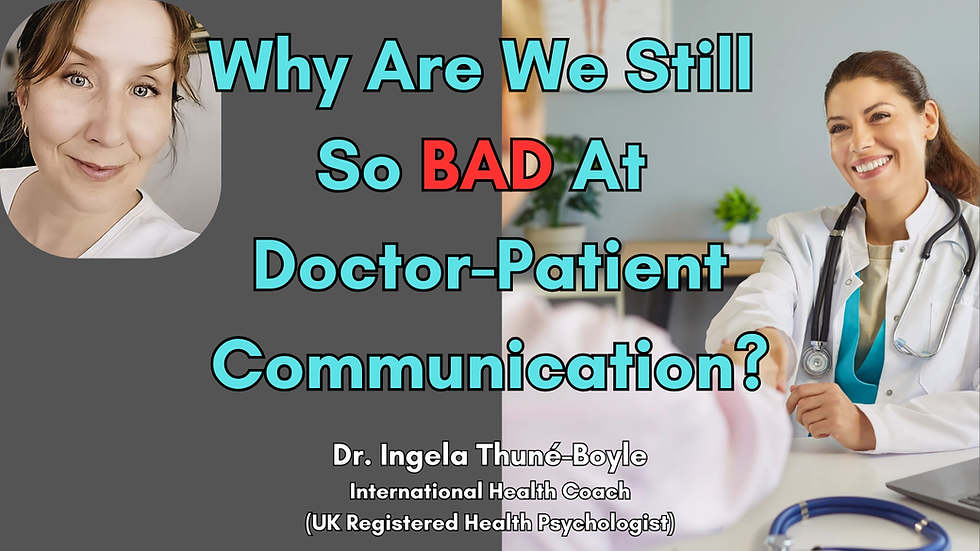
Mockery in Medicine: When Doctors Belittle Patients on Social Media

Updated: Sep 28, 2025

In recent years, a troubling trend has emerged in the online presence of some healthcare professionals: the mocking of patients and their conditions on social media. What might seem to a doctor like lighthearted banter, professional critique, or debunking of pseudoscience can, in fact, come across as dismissive ridicule of people’s suffering. Terms such as “adrenal fatigue,” “mitochondrial challenges,” or “chronic Lyme” become punchlines, shorthand for what some professionals deem non-real or unscientific illnesses. Yet behind each of these labels is a person, often struggling and searching desperately for answers when conventional medicine has left them without relief.
The emergence of social media has blurred the distinction between professional environments and public conversation. Doctors, who historically expressed skepticism through journals, conferences, and peer-reviewed articles, now share opinions in quick, viral posts. Their words are not only read by colleagues but also by patients, caregivers, and entire communities of people affected by chronic and poorly understood conditions. When these posts mock or belittle, they do not simply challenge an idea, they risk dehumanizing the individuals who live with the pain and fatigue those ideas are trying to name.
Patients who turn to alternative or controversial diagnostic labels are rarely doing so frivolously. More often, they are individuals who have endured years of unexplained symptoms, inconclusive lab results, and the frustration of feeling dismissed within mainstream healthcare. In this context, terms like “adrenal fatigue” or “mitochondrial challenges” function less as precise medical jargon and more as survival tools, i.e. ways of naming otherwise invisible suffering and connecting with communities that validate their experiences. To see doctors mocking these terms online can therefore reinforce the very alienation that drove patients toward them in the first place.
At the same time, it is important to note that the concepts patients reach for are not entirely without basis. Mitochondrial dysfunction is a documented concern in certain conditions, including long-Covid, and there is growing evidence that trauma and chronic stress can disrupt mitochondrial function, impairing energy production and leaving individuals more vulnerable to fatigue, inflammation, and illness. Similarly, although “adrenal fatigue” is not recognized by conventional endocrinology, many functional and integrative practitioners use it as a shorthand for the cluster of symptoms linked to chronic stress. Seen in this light, patient language such as “mitochondrial challenges” or “adrenal fatigue” reflects not ignorance, but an attempt to make sense of lived realities that biomedical categories have yet to fully capture.
Mockery also erodes trust in medicine. Healthcare, at its best, depends on empathy, humility, and open dialogue. When patients see professionals ridiculing their language of suffering, they may withdraw further from conventional medical care, feeling unwelcome or shamed. In turn, this can deepen the divide between patients and providers, pushing people toward potentially unsafe or unregulated treatments. Ironically, what may have begun as an effort by clinicians to protect patients from what they perceive as misinformation instead drives them away from care altogether.
The underlying problem is not skepticism itself - science requires questioning - but the tone and medium through which skepticism is expressed. Constructive critique might look like explaining why something is not a medically recognized condition while validating that the fatigue, exhaustion, pain, and distress people experience are very real and worthy of care. Mockery, on the other hand, signals that suffering is not being taken seriously, which can be profoundly damaging for individuals already living with stigma. And we must also recognize that medicine does not hold all the answers. Humility - acknowledging uncertainty and the limits of current knowledge - is essential to preserving trust and ensuring patients feel respected rather than dismissed.
Ultimately, healthcare professionals must remain mindful of the weight their voices carry in public spaces. Social media has enormous potential to educate, to destigmatize, and to foster understanding. Yet it also carries the responsibility to remember that patients are listening. Behind every disputed diagnosis is a human being navigating uncertainty, seeking hope, and yearning to be believed. Doctors may not endorse every term or theory patients and other professionals adopt, but they have a duty to honour the suffering those terms represent. Compassion, not ridicule, should guide their public discourse.
If this is something you’ve been affected by, please leave a comment below. If there’s something important you’d like to add, please do so. I'd love to hear from you.
If you liked this post or know someone who might find it useful, please share. You can also join my mailing list at www.ingelathuneboyle.com for regular blog notifications straight to your inbox! Please check out my other blog posts here.
------------------------------------------------
Dr. Ingela Thuné-Boyle is a licensed Practitioner Health Psychologist and a Doctor in Behavioural Medicine who specializes in stress and loss, especially in improving the quality of life of people struggling with long-term health problems, chronic pain and (medical) trauma. She runs a private online (telehealth) practice at www.ingelathuneboyle.com.
Please note: Advice given in this blog is not meant to take the place of therapy or any other professional advice. The opinions and views offered by the author is not intended to treat or diagnose, nor is it intended to replace the treatment and care that you may be receiving from a licensed physician or mental health provider. The author is not responsible for the outcome or results following their information and advice on this blog.